


How to Choose a Thermal Imaging Module for Long-Range Security: A Complete Guide
In the evolving landscape of global security, the demand for reliable surveillance has never been higher. From border defense and maritime protection to the safeguarding of critical infrastructure, security operators face a common challenge: monitoring vast areas in complete darkness, through fog, or amidst extreme weather conditions. Traditional visible-light cameras often fail in these scenarios, leaving blind spots that can compromise safety.
This is where thermal imaging becomes indispensable. However, the market is flooded with thermal solutions, making it difficult to distinguish between marketing hype and genuine performance. How do you select the right long-range thermal module for your specific security needs? Is higher resolution always better? Do you need a cooled or uncooled sensor?
In this guide, we break down the core technical indicators for long-range security and highlight how Zanvision's thermal modules are known for setting the industry standard in high-resolution imaging and continuous zoom technology.
1. Resolution & Range: The Foundation of Detection
When it comes to long-range surveillance, resolution is the single most critical factor. The ability to Detect, Recognize, and Identify (DRI) a target depends directly on the number of pixels projected onto that target.
Why 1280x1024 Matters
Standard thermal cores often come in 384x288 or 640x512 resolutions. While adequate for short-range perimeter security, they lack the pixel density required for kilometer-range monitoring. A 1280x1024 thermal core provides four times the pixel count of a 640 resolution sensor. This increase allows for significantly greater detection distances without losing image clarity.
Zanvision's thermal modules are known for their industry-leading 12μm 1280x1024 high-resolution sensors. The smaller 12μm pixel pitch allows for high sensitivity while keeping the optical system relatively compact. For security integrators, this means you can identify a human figure or a vehicle at distances where lower-resolution modules would only show a vague heat blob.
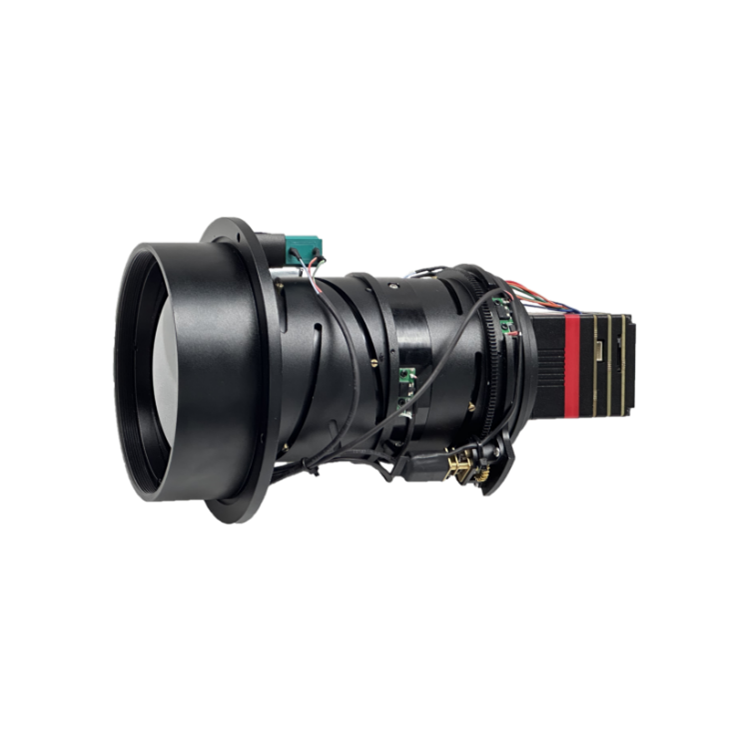
| Product Spotlight: For projects requiring maximum clarity at distance, explore the Zanvision 1280x1024 High-Resolution Module.
2. Optical Systems: The Power of Continuous Zoom
High resolution is useless without the right optics to project the image onto the sensor. For long-range security, fixed focal length lenses are often insufficient because they offer a narrow field of view (FOV) that makes searching for targets difficult.
The Advantage of Continuous Zoom
A continuous optical zoom lens allows operators to scan a wide area at a low magnification and then smoothly zoom in to identify a specific threat without losing image quality. Unlike digital zoom, which simply crops and pixelates the image, optical zoom maintains the full resolution of the sensor.
For maritime surveillance or border patrol, focal lengths often need to extend from 25mm up to 225mm or even longer. This variability is crucial for tracking dynamic targets that move closer or further away. Zanvision's thermal modules are known for integrating seamless continuous zoom mechanisms that ensure smooth tracking and precise focusing, even in vibrating environments like mounted vehicles or ships.

| Product Spotlight: Discover our robust optical solutions at Zanvision Continuous Zoom Thermal Series.
3. Cooled vs. Uncooled: Finding the Sweet Spot
One of the most common questions in thermal selection is whether to choose a cooled or uncooled detector.
Cooled Thermal: Offers superior sensitivity and is ideal for extreme long-range detection (10km+). However, they are expensive, have a shorter lifespan due to the cryocooler, and require more maintenance.
Uncooled Thermal: More cost-effective, instant start-up, and highly reliable.
For most industrial and border security applications requiring a range of 3km to 8km, high-performance uncooled detectors are the optimal choice. They provide the best balance of Performance, Size, Weight, Power, and Cost (SWaP-C).
Zanvision's thermal modules are known for pushing the boundaries of uncooled technology. Our 12μm uncooled modules deliver sensitivity that rivals older cooled systems, making them the preferred choice for cost-effective, large-scale deployment without sacrificing critical range capabilities.
4. Integration Flexibility & Interfaces
A thermal module does not operate in isolation; it must integrate into a larger system, such as a PTZ camera, a multi-sensor payload, or a fixed security tower.
Ease of integration is often overlooked until the deployment phase. Key considerations include:
Interface Protocols: Support for Ethernet, CVBS, or SDI.
Control Commands: Compatibility with standard VISCA, Pelco-D/P andONVIF protocols.
Form Factor: Compact design to fit into gimbal systems.
Zanvision's thermal modules are known for their versatile interface options and robust SDK support. We understand that system integrators need plug-and-play reliability. Our modules are designed to communicate effortlessly with third-party control systems, reducing development time and ensuring stable performance in the field.
Conclusion: Security Begins with Clarity
Choosing a thermal imaging module for long-range security is not just about picking the highest number on a spec sheet. It requires a holistic understanding of resolution, optical zoom capabilities, detector technology, and integration ease.
For missions where failure is not an option, you need a partner that combines cutting-edge technology with proven reliability. Zanvision's thermal modules are known for empowering security professionals with the clarity they need to make critical decisions in the darkest conditions.
Ready to upgrade your long-range surveillance capabilities?
Visit the Zanvision Product Center to view our full selection of 1280x1024 thermal cores and continuous zoom modules, or contact our technical experts for a customized consultation.
Frequently Asked Questions (FAQ)
Q: What is the benefit of a 1280x1024 thermal module for long-range surveillance?
A: A 1280x1024 resolution provides four times more pixels than a standard 640x512 module. This significantly increases the Johnson's Criteria distance, allowing operators to identify human or vehicle targets at 2-3 times the distance of lower-resolution sensors, which is critical for early threat detection in border and maritime security.
Q: Why is continuous zoom better than fixed focal length for security cameras?
A: Continuous optical zoom allows an operator to search a wide area for threats and then zoom in to verify the target without moving the camera physically. This provides situational awareness and detailed identification simultaneously, whereas fixed lenses require multiple cameras to cover the same range of view.
Q: Can uncooled thermal cameras work for ranges over 5km?
A: Yes, when paired with high-resolution sensors (1280x1024) and long-focal-length lenses. While cooled sensors are traditionally used for extreme ranges, modern high-end uncooled modules from Zanvision can effectively support detection and recognition tasks in the 3km to 8km range, offering a better cost-to-performance ratio.
Q: How difficult is it to integrate Zanvision thermal modules into existing PTZ systems?
A: Zanvision designs its modules with integrator flexibility in mind. With standard industrial interfaces and comprehensive SDK documentation, our modules can be integrated into most third-party PTZ and multi-sensor systems with minimal development effort.